
A New View of the Sun’s Corona
The Belgian-led ASPIICS coronagraph aboard ESA’s Proba-3 mission reveals a dynamic birthplace of the solar wind
Observations made by the ASPIICS coronagraph aboard the Proba-3 mission of ESA reveal a world of small-scale activity in the Sun’s inner corona, according to a new study led by the Royal Observatory of Belgium. These observations suggest that the region where the solar wind forms is filled with constantly moving structures that may help drive the solar wind itself.
The Sun’s extended atmosphere, the solar corona, is a realm of extremes. Temperatures exceed a million degrees — much hotter than the solar surface — and from this place streams a continuous supersonic flow of plasma (electrically charged gas) known as the solar wind. The slower component of this wind, the slow solar wind, is particularly puzzling: it varies strongly in speed, density, and composition, and its exact origin in the inner corona has remained debated for decades.
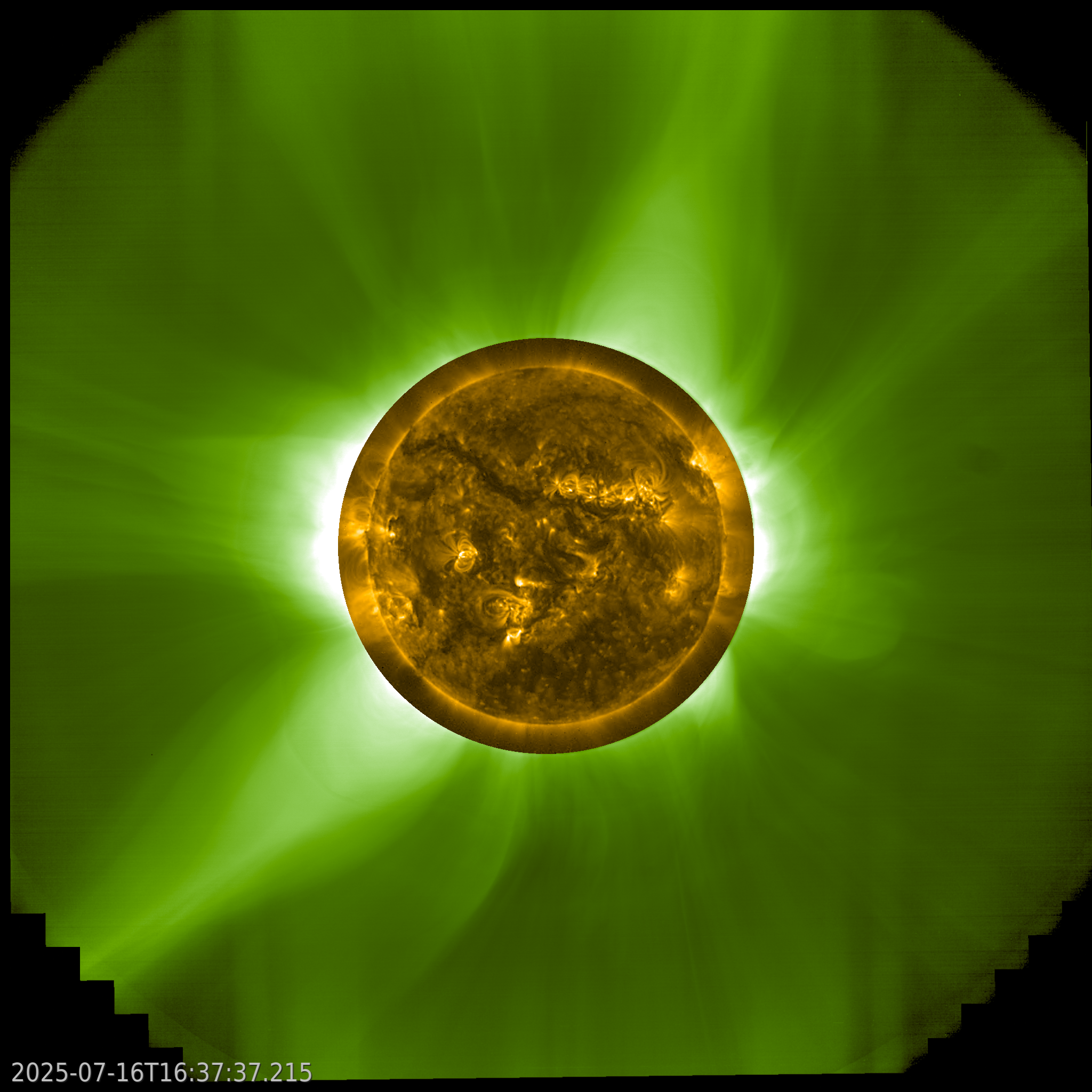
This image was recorded on 16 July 2025. At this time, the Sun was at solar maximum, the most active time in the 11-year solar cycle. This meant streamers carrying solar wind could point in all directions. As the Sun’s activity slows down over the next few years and the Sun’s magnetic field becomes less chaotic, streamers will mostly come from near the solar equator. The (artificially coloured) yellow part of the image shows the Sun in ultraviolet light, recorded by the SWAP telescope on ESA’s Proba-2 spacecraft. The green image around it was captured in visible light by the ASPIICS coronagraph on ESA’s Proba-3. Credit: ESA/Proba-3/ASPIICS & ESA/Proba-2/SWAP, A. Zhukov (ROB).
Observing the inner part of the solar corona has long been difficult. Telescopes that view the Sun with its low corona in X-rays and extreme ultraviolet usually cannot see far enough outward, while traditional coronagraphs — instruments that block the bright solar disk to reveal the faint corona — typically observe the corona farther from the Sun. This results in an observational gap exactly where the slow solar wind is thought to form.
The Proba‑3 mission of the European Space Agency (ESA), launched in December 2024, uses a unique technique to close this gap: two spacecraft flying in millimetrically precise formation 144 metres apart. One satellite carries a disk that covers the bright solar surface, while the other hosts a telescope. Together they form a giant coronagraph that creates artificial total solar eclipses in space on demand, allowing scientists to observe the faint corona very close to the Sun for hours at a time. The mission’s main instrument, the ASPIICS coronagraph (Association of Spacecraft for Polarimetric and Imaging Investigation of the Corona of the Sun) effectively fills the observational gap between extreme-ultraviolet solar telescopes and traditional coronagraphs.
The (artificially coloured) yellow part of the video shows the Sun in ultraviolet light, recorded by the SWAP telescope on ESA’s Proba-2 spacecraft. The greyscale area around it is based on data captured in visible light by the ASPIICS coronagraph on Proba-3. This data is processed to enhance contrast. You can see flows of solar wind moving away from the Sun in all directions. In some regions, particularly around the bottom of the video, you can see some material also falling back towards the Sun. In the second half of the video, a coronal mass ejection expands towards the right. Credit: ESA/Proba-3/ASPIICS & ESA/Proba-2/SWAP (ROB), A. Debrabandere (ROB).
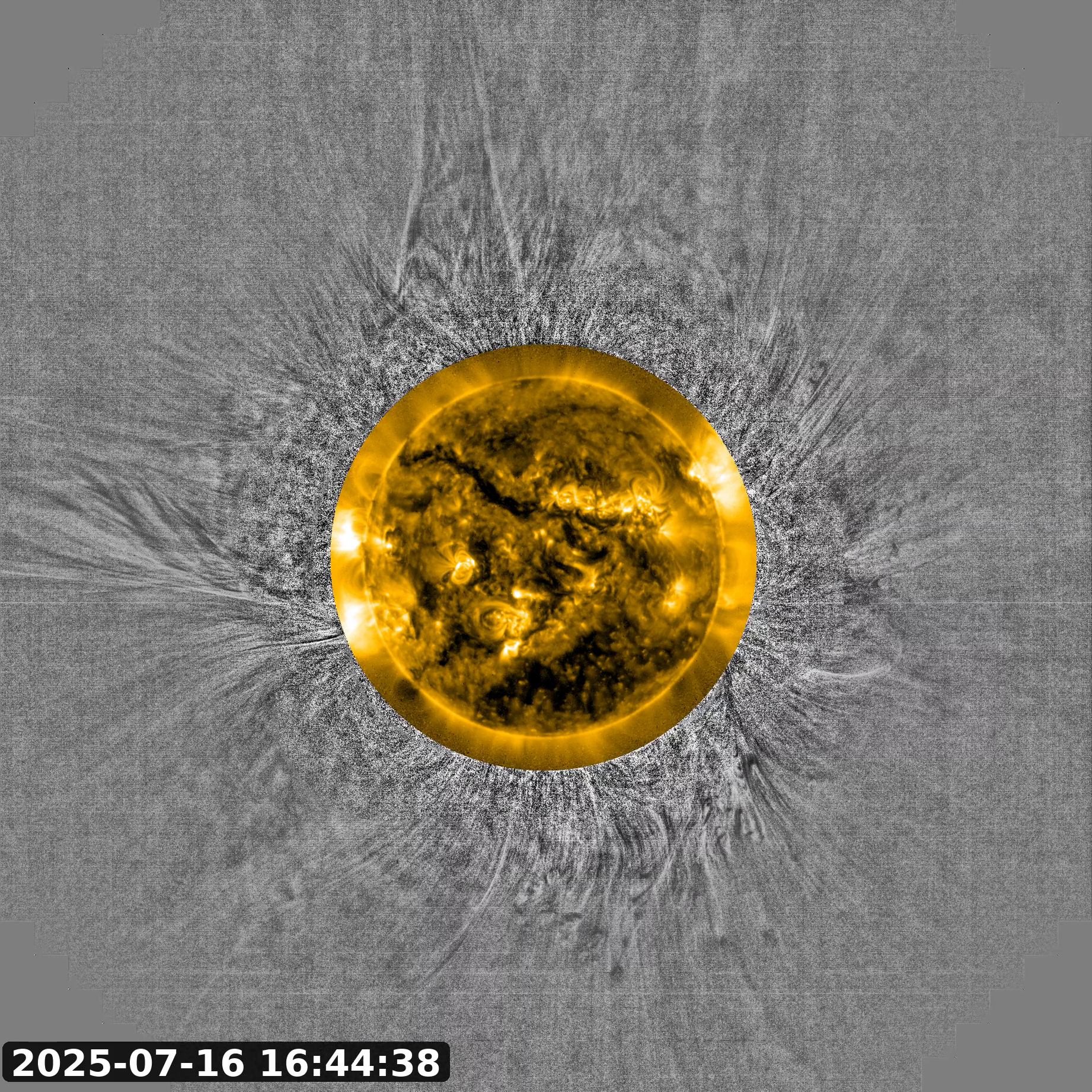
Watch the full video. The (artificially coloured) yellow part of the video shows the Sun in ultraviolet light, recorded by the SWAP telescope on ESA’s Proba-2 spacecraft. The greyscale area around it is based on data captured in visible light by the ASPIICS coronagraph on Proba-3. This data is processed to enhance contrast. You can see flows of solar wind moving away from the Sun in all directions. In some regions, particularly around the bottom of the video, you can see some material also falling back towards the Sun. In the second half of the video, a coronal mass ejection expands towards the right. Credit: ESA/Proba-3/ASPIICS & ESA/Proba-2/SWAP (ROB), A. Debrabandere (ROB).
In a new study led by the Royal Observatory of Belgium and published in the Astrophysical Journal Letters, researchers present the first scientific results from Proba-3/ASPIICS. ‘The observations reveal that the region where the slow solar wind originates is filled with ubiquitous small-scale dynamics: tiny, faint, rapidly evolving plasma structures flowing outward, but also sometimes inward, through the corona,’ says Andrei Zhukov, the Principal Investigator of ASPIICS and the lead author of the study. These motions indicate that the solar corona is far more dynamic at small scales than previously observed. Such dynamics may be linked to magnetic reconnection — the rearrangement of magnetic fields that may heat and accelerate plasma. Tracking these tiny structures provides new clues about how the slow solar wind forms and how the Sun releases mass and energy into the interplanetary space.
Proba-3 is an ESA mission involving scientific and industrial partners across Europe. Belgium plays a central role in the mission’s technology and science:
- Redwire in Kruibeke provided spacecraft avionics, assembly, testing, and early operations.
- The Centre Spatial de Liège led the design, assembly and testing of the ASPIICS telescope, and served as the industrial prime contractor, coordinating a large European consortium that built the instrument.
- The Royal Observatory of Belgium leads the scientific investigation, including the instrument’s Principal Investigator team and the mission’s science operations.
The Proba-3 spacecraft are operated from ESA’s European Space Security and Education Centre in Redu. The strong Belgian involvement reflects decades of expertise in solar physics and development of space hardware.
The first results mark only the beginning of Proba-3’s exploration of the solar corona. ‘Since the start of its nominal mission in July 2025, Proba-3/ASPIICS acquired more than 250 hours of data, which is equivalent to the duration of thousands of natural total solar eclipses observed from the ground,’ says Andrei Zhukov. Scientists expect Proba-3 to uncover even more new details about fundamental processes in the corona, such as how the solar wind is produced, and how magnetic eruptions known as coronal mass ejections are launched from the Sun.
The Belgian contribution to Proba-3 is supported by the GSTP and PRODEX programmes of ESA, by the Belgian Federal Science Policy Office (BELSPO), and by the Solar-Terrestrial Centre of Excellence.
ESA web story: https://www.esa.int/Science_Exploration/Space_Science/First_Proba-3_science_surprisingly_speedy_solar_wind