
Late growth spurt of young stars allows giant planets to form after all
Brussels, 3 December 2025 – By measuring the rate at which young stars grow, astronomers discovered that contrary to earlier expectations, young stars appear to grow much faster in the later stages of their formation than at the onset. So, much like humans, intermediate mass stars undergo a growth spurt and have a voracious appetite during their adolescence. This finding, reported by an international team led by Sean Brittain of Clemson University USA, and including René Oudmaijer of the Royal Observatory of Belgium, solves a long-standing problem with giant planets that are routinely detected around stars of intermediate mass, but should not exist.
Young stars begin their life surrounded by a disk of gas and dust. Over the past 40 years, astronomers have established that the material in this disk gradually falls onto the young star as it grows and matures. The disk is ionized by radiation from the star, which causes it to spread, like a mound of clay on a potter’s wheel. Some of this material falls onto the star, some is blown away, and some of it forms into planets. As the disk dissipates, the rate at which material falls onto the star decreases as well. Ultimately the star reaches its final mass and further planet formation comes to a halt.
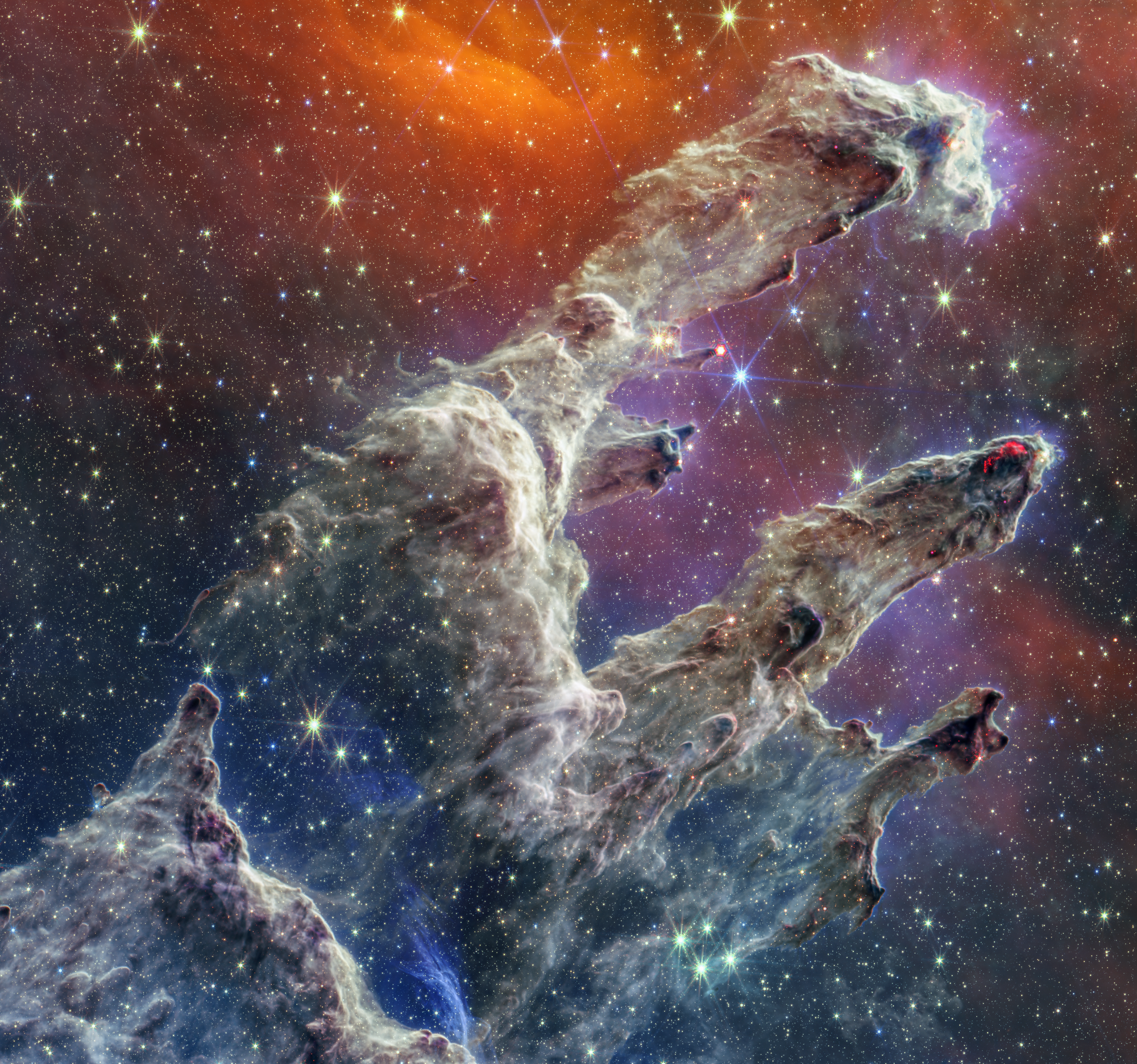
This image combines data from Webb’s near- and mid-infrared observations of the Pillars of Creation, including thousands of stars that show up in near-infrared light, and all the dust that pops out in mid-infrared light.
NASA, ESA, CSA, STScI; Image Processing: Joseph DePasquale (STScI), Alyssa Pagan (STScI), Anton Koekemoer (STScI). Source: https://science.nasa.gov/asset/webb/pillars-of-creation-nircam-and-miri-composite-image/
This theory does a very good job at explaining the formation of stars similar to the Sun, but it has been challenged by the observations of young stars that are slightly more massive. These stars were found to be gaining mass at much higher rates than expected.
How can astronomers measure the growth rate of stars? As Professor Sean Brittain explains, ‘When material falls onto a star, a lot of energy is released, just like when you drop a chair it will make a noise or even break. In the case of material being accreted, the energy released is much greater. We can see this as extra radiation coming from the system, and this allows us to determine the rate at which the stars grow in mass.’
The team studied young stars, also referred to as Herbig stars that are hotter and more massive than our Sun. Their accretion rates were already well studied and – as expected – observed to decrease with age as the stars reach their full maturity. However, it also meant that in their earlier phases, the stars must accrete at even higher rates than observed now.
Team member Dr René Oudmaijer, from the Royal Observatory of Belgium, says, ‘This implied that the disks surrounding these stars must start out to be very massive indeed. This would pose a problem because such massive disks would be unstable and break up before planets even have the chance to be formed.’
Recent surveys identified stars that would evolve into Herbig stars which prompted the team to study how the accretion rates of these younger objects would differ from those of the Herbig stars. What they found was unexpected as team member Dr Gwendolyn Meeus of the Universidad Autónoma de Madrid in Spain comments: ‘Instead of higher accretion rates, we found values that were up to 30 times lower than those of the Herbig stars. In a way this would solve the mass problem, as the disk does not need to be so massive to begin with.’ But this posed yet another problem as Brittain continues: ‘Theory would predict that the stars accrete less material over time, not more. This new finding needs an explanation based on well-grounded physics if we are to change our current thinking.’
The team found that there was one key ingredient missing in the models so far. The so-called Herbig stars have high temperatures, but their precursors start out much cooler. It is precisely the stellar temperatures that affect the disks and determine how quickly they lose their material to the star. A star that gets hotter will gradually emit much more ultraviolet radiation. This in turn ionizes the gas in the circumstellar disks, which then results in an increasingly larger accretion onto the star.
The long-standing mystery that gas giant planets around intermediate mass stars were observed, but not predicted to exist, appears to be solved with this work. ‘Indeed,’ as team member Josh Kern of Clemson University concludes, ‘this unexpected late growth spurt opens up the possibility for giant planets to be formed in the earlier stages, when the stars are still much cooler, after all.’
The findings are published in the Astronomical Journal.
The article:
Brittain et al., ‘Evolution of the Accretion Rate of Young Intermediate Mass Stars: Implications for Disk Evolution and Planet Formation’ The Astronomical Journal, DOI: 10.3847/1538-3881/ae1a42, published online.