
Second workshop on Belgian Time and Frequency Services (BTFS)
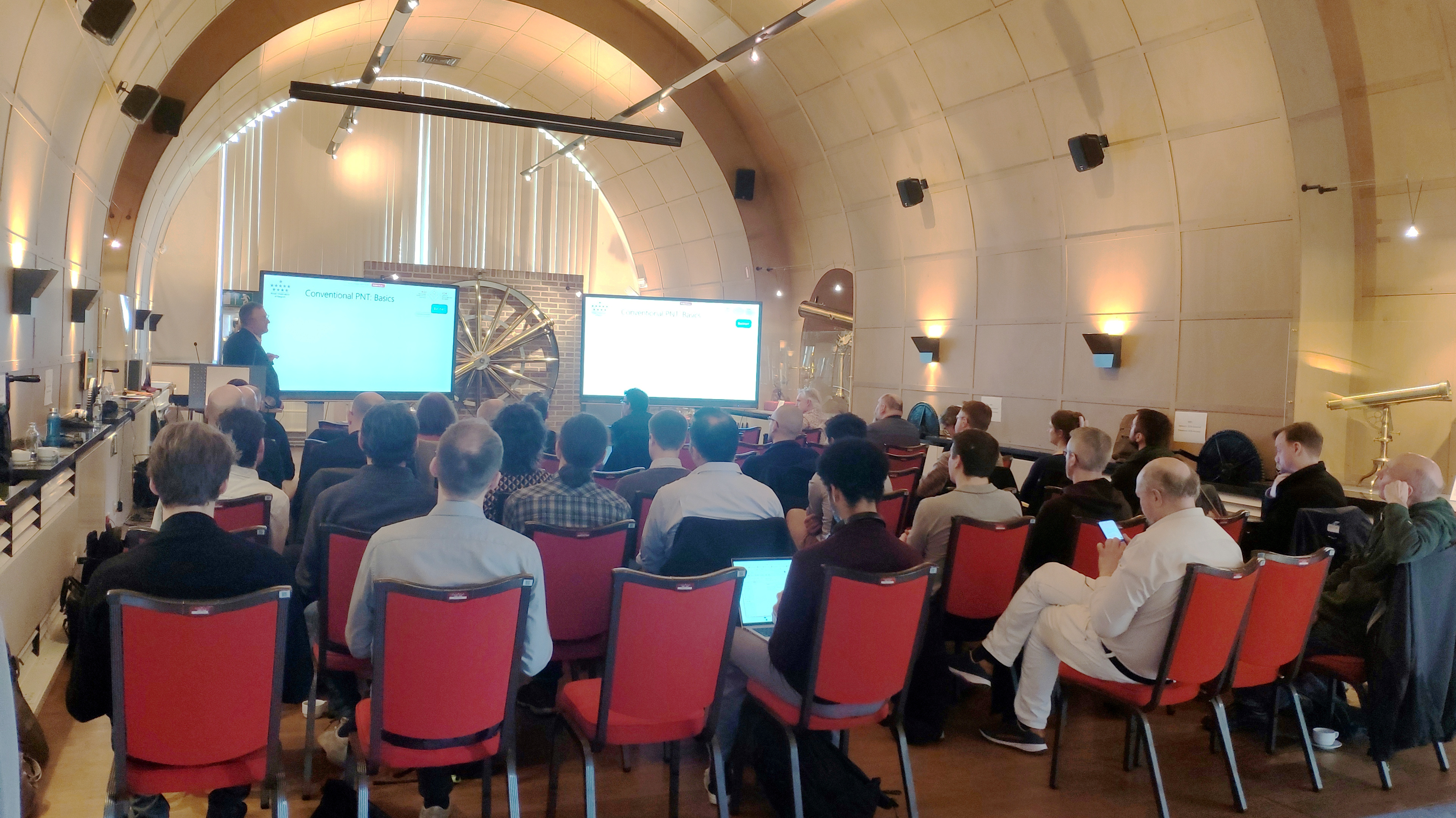
On Tuesday 10 March 2026, the second workshop on Belgian Time and Frequency Services (BTFS) was held at the Royal Observatory of Belgium (ROB). It brought together around thirty interested participants to discuss the latest developments and applications. Thanks to the use of an optical network for the distribution of time and frequency signals, this technology is immune to GNSS threats such as jamming and spoofing, which significantly improves signal reliability. The high participation in this workshop confirms a growing interest in BTFS.
Extension of the Belgian network
The workshop was opened by Koen Lefever of Belspo, sponsor of the BOOSTED project, which aims to develop an optical time and frequency transfer network. Raphaël Marion (ROB) then presented an overview of the Belgian time and frequency network. He explained the commissioning of the first section in December 2025 and outlined the ambitious expansion plans for 2026. New connections are planned, notably to the metrology service of the FPS Economy and to the universities of Mons and Louvain-la-Neuve. A connection to GÉANT’s pan-European Core Time & Frequency Network (C-TFN) is also on the roadmap.
Need for a robust network
Although BTFS were initially developed for scientific research, interest from other sectors is growing rapidly. In particular, the telecommunications, energy and transport sectors are showing an interest in an independent and extremely accurate time signal to enhance the security and reliability of their critical infrastructure. This development is fully in line with the vision of the European Commission’s Joint Research Centre (JRC). During his presentation, Lukasz Bonenberg emphasised the importance of developing robust, GNSS-independent terrestrial time synchronisation networks. According to the JRC, such networks are essential for building a resilient European positioning, navigation and time synchronisation (PNT) system.
The Netherlands and Switzerland
International experiences were also presented. The Dutch organisation SURF proudly announced the commissioning of its national time and frequency network for research and education. Since January 2026, a White Rabbit time signal, originating from the National Metrology Institute VSL in Delft, has been distributing the legal time UTC(VSL) to eleven sites via SURF’s fibre-optic network.
Furthermore, METAS, the Swiss National Metrology Institute, presented several practical applications of its network. In Switzerland, a 450-kilometre network is now operational for the distribution of White Rabbit time signals, primarily used by the financial sector, defence and telecommunications. An optical frequency signal is also broadcast for advanced scientific applications, such as precision spectroscopy and fibre sensing.
Technology and innovation
The second part of the workshop focused on technical aspects. Lisa Van Loo (Belnet) and Guillaume Le Portz (ORB) presented the architecture of the BTFS network as well as the excellent monitoring results from the first connections.
Net Insight then presented its Zyntai technology, an innovative solution that operates as an overlay on existing IP networks. By performing statistical weighting of multiple time sources, this technology—which is compatible with the BTFS network—enables the distribution of a precise time signal over long distances, with performance levels falling between PTP and WR.
Finally, Prof. Kasper Van Gasse of the Photonics Research Group (UGent and imec) presented ongoing research into integrated photonics. This work aims to develop lasers that are more compact, more robust and easier to manufacture, with applications in metrology and quantum technologies.
The workshop concluded with a relaxed get-together over drinks, giving participants the opportunity to share their experiences and explore new avenues for collaboration. This second edition clearly confirmed the growing importance of reliable time distribution, as well as the keen interest shown by both the scientific community and industry.